
Why is my toddler waking at 5am, and what helps?
A toddler who is up at five is usually not done sleeping; they are awake, and they have no way of knowing it is not morning yet. The fixes are mostly about the evening before and about giving them a signal they can read. A sleep clock is that signal.
The usual reasons
Sleep consultants list the same handful of causes, and most early risers have more than one:
- Bedtime is too late, or too early. An overtired toddler sleeps worse, and one put down before they are tired wakes early because they are done.
- Light. Summer mornings and a landing light both say “morning” to a two-year-old.
- Naps. A nap that is too long, too late or dropped too soon moves the morning.
- Hunger, a nappy, teeth, a cold. The ordinary things.
- Habit. If getting up at five has been rewarded with company and breakfast, it stays.
- A change. A new bed, a trip, potty training, the clocks going back.
The NHS says toddlers and preschoolers need 10 to 14 hours of sleep a day, naps included, and to be consistent with bedtimes and naptime. Source: Sleep routines for toddlers and children, Cambridgeshire and Peterborough NHS (https://cambspborochildrenshealth.nhs.uk/sleep/healthy-sleep-routines/sleep-routines-for-toddlers-and-children/).
What helps
- Treat it as night. Low voice, no lights, no breakfast, back to bed; the same as a waking at two in the morning.
- Make the room dark. A blackout blind does more than any gadget in summer.
- Look at the whole day. Move bedtime by fifteen minutes at a time and give it a week before judging; check the nap.
- Give them a signal. This is what a sleep clock is for: something in the room that says “not yet” without you, and “now” when it is time. With SlumberPal, six stars go out one by one through the night and the sun comes up at the time you set. A toddler cannot read a clock; they can see whether the sun is up.
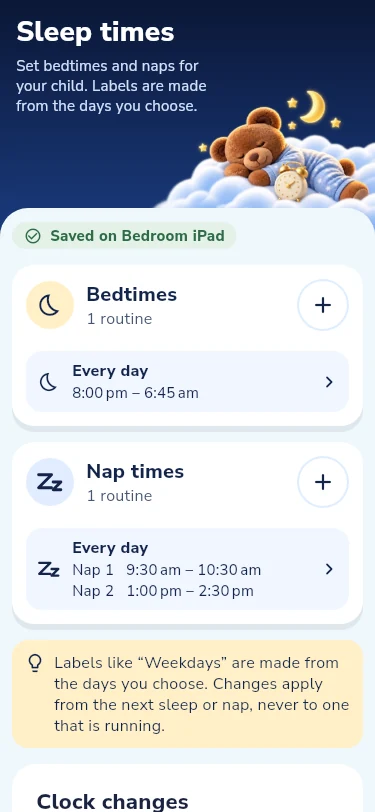
- Set the wake time where they are, then move it. If they wake at five, set the sun for five-fifteen for a few days, then later in ten or fifteen-minute steps. You change the time from your phone; there is nothing to reprogramme by the bed.
- Reward the wait, not the waking. When the sun comes up, a present appears on the screen with a toy for their shelf. Staying in bed until then is the thing that gets noticed.
SlumberPal does not promise a different wake time. It promises a clear, calm signal they can read, and that you can change it from your phone.
The clock-change weeks
Twice a year, in late March and late October, the clocks move and a toddler’s body does not. The week before, move bedtime and the wake time by ten or fifteen minutes a day towards the new time, and move naps and meals with them. SlumberPal keeps the times you set in your home time zone and handles the change itself; what you move by hand, you move from your phone. Away from home, choose whether to keep home times or use the new time zone from the next sleep.
When to ask for help
If early waking comes with snoring, pauses in breathing, or a child who is exhausted in the day, talk to your GP or health visitor. A sleep clock is not a treatment.
Questions
From what age does a sleep clock work?
From about two and a half, with most children understanding it by three. Before that it is still a calm bedtime signal.
What if they wake and the stars are still out?
Nothing on the screen changes, and nothing responds to a tap. The stars say “not yet”. You do what you would do at any night waking.
Can I change the wake time without going in?
Yes, with Plus: add fifteen minutes, or start the morning now, from your phone, while the app is open on the screen.
Does it work for naps?
Yes. Each nap has its own stars and its own wake, and the morning present is optional after naps.
Will the screen itself wake them?
The night scene is dark, still and as dim as you set it. See screens and sleep.